
Grams to Milliliters Converter
Convert grams to milliliters and milliliters to grams using ingredient-specific densities for accurate kitchen results.
Click to browse all 140+ ingredients, or type to search.
Ingredient weights can vary depending on how an ingredient is measured, packed, or scooped. Results are estimates based on standard reference measurements.
Quick Conversion Table
| Grams | Milliliters |
|---|---|
| 50 g | 50 |
| 100 g | 100 |
| 150 g | 150 |
| 200 g | 200 |
| 250 g | 250 |
| 500 g | 500 |
Values shown for Water. Change the ingredient above to update.
Grams measure weight; milliliters measure volume. Converting between the two isn’t a simple 1:1 exchange — it depends entirely on the ingredient’s density. Our grams to milliliters converter handles this automatically for 140+ ingredients. Whether you’re working with water, milk, honey, olive oil, or flour, the tool gives you a precise mL value in real time. Need to go the other way? The swap button converts milliliters to grams just as easily.
Most people assume 1 gram equals 1 milliliter, but that’s only true for water. Honey is much denser than water — 100 grams takes up just 70 mL. Flour is much lighter — 100 grams takes up 189 mL. That’s why our grams to milliliters converter uses ingredient-specific densities rather than a single formula. Getting the density right matters, especially in baking and brewing, where small differences change the final result.
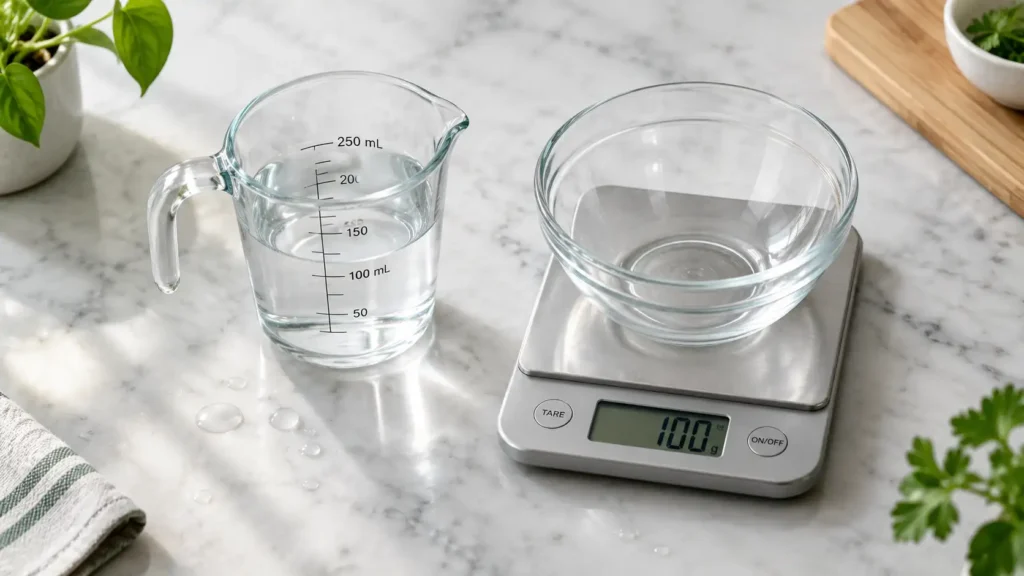
Table of Contents
How to Convert Grams to Milliliters
The conversion formula is straightforward once you know the ingredient’s density:
milliliters = grams ÷ density (g/mL)
Milliliters in this converter follow the metric system defined by NIST, the U.S. authority on measurement standards.
For example:
- 100 g water (density 1.0 g/mL) = 100 mL
- 100 g all-purpose flour (density 0.53 g/mL) = 189 mL
- 100 g honey (density 1.42 g/mL) = 70 mL
- 100 g olive oil (density 0.91 g/mL) = 110 mL
- 100 g granulated sugar (density 0.85 g/mL) = 118 mL
And to convert milliliters back to grams:
grams = milliliters × density (g/mL)
For example, 100 mL of honey × 1.42 = 142 g.
When 1 Gram Equals 1 Milliliter (And When It Doesn’t)
The common belief “1 g = 1 mL” only holds for pure water at room temperature. Every other ingredient has a different density:
| Ingredient | Density (g/mL) | 100 g in mL |
|---|---|---|
| Water | 1.00 | 100 mL |
| Milk | 1.03 | 97 mL |
| Honey | 1.42 | 70 mL |
| Olive oil | 0.91 | 110 mL |
| Butter (melted) | 0.96 | 104 mL |
| All-purpose flour | 0.53 | 189 mL |
| Granulated sugar | 0.85 | 118 mL |
| Cocoa powder | 0.36 | 278 mL |
Ingredient densities on this page follow reference values from the USDA FoodData Central database and standard culinary measurement guides.
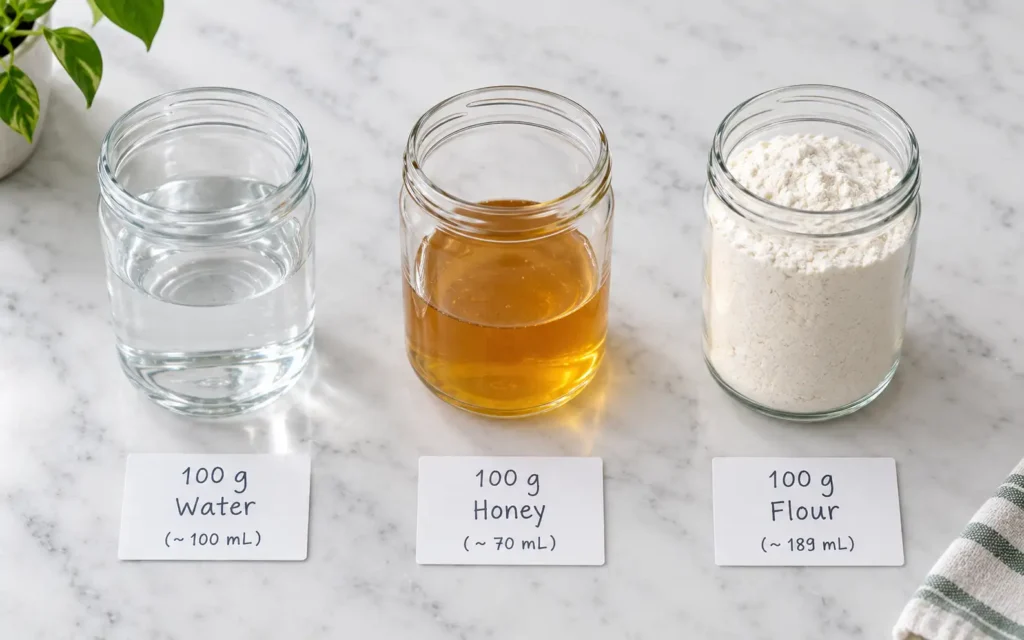
The lighter the ingredient, the more space 100 grams takes up. Flour and cocoa powder are much lighter than water, so 100 g of either occupies far more volume. Honey and syrup are heavier, so 100 g fits into less space.
Common Grams to Milliliters Conversions
Here’s a quick reference for the most common ingredients and weights. For anything else, use the converter at the top of this page.
Water: Grams to Milliliters
| Grams | Milliliters |
|---|---|
| 50 g | 50 mL |
| 100 g | 100 mL |
| 200 g | 200 mL |
| 500 g | 500 mL |
| 1000 g | 1000 mL |
Water is the one ingredient where grams and milliliters are interchangeable (at 4°C, density is exactly 1 g/mL; at room temperature it’s slightly less, but negligible for cooking).
Milk: Grams to Milliliters
| Grams | Milliliters |
|---|---|
| 50 g | 49 mL |
| 100 g | 97 mL |
| 200 g | 194 mL |
| 500 g | 485 mL |
Honey: Grams to Milliliters
| Grams | Milliliters |
|---|---|
| 50 g | 35 mL |
| 100 g | 70 mL |
| 200 g | 141 mL |
| 500 g | 352 mL |
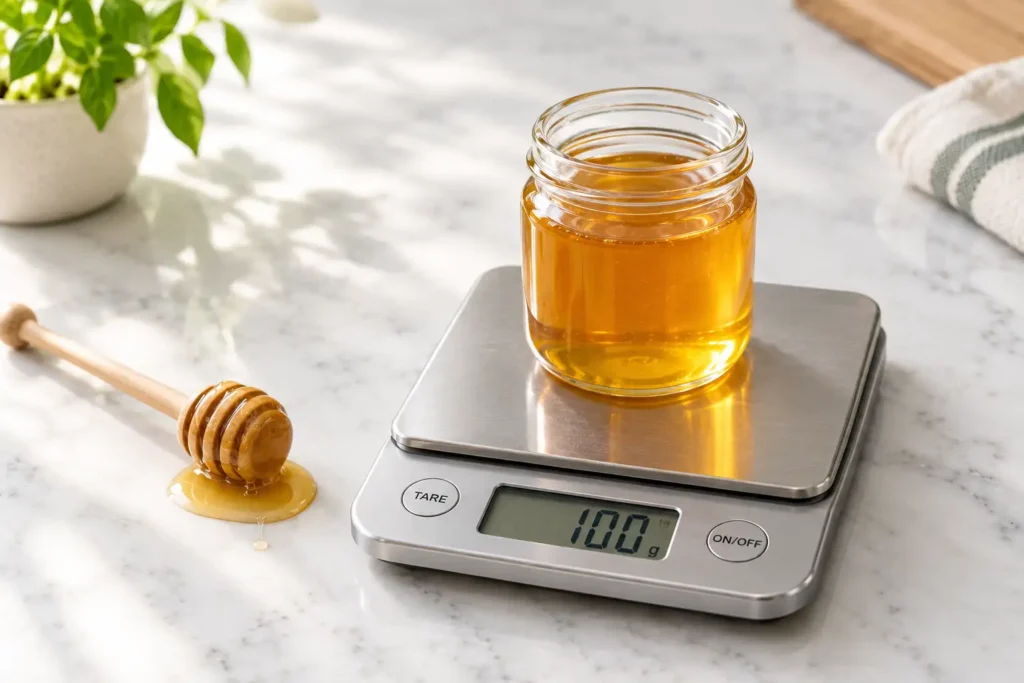
Honey is one of the densest ingredients in the kitchen — 100 g takes up far less space than 100 g of water.
Olive Oil: Grams to Milliliters
| Grams | Milliliters |
|---|---|
| 50 g | 55 mL |
| 100 g | 110 mL |
| 200 g | 220 mL |
| 500 g | 549 mL |
All-Purpose Flour: Grams to Milliliters
| Grams | Milliliters |
|---|---|
| 50 g | 94 mL |
| 100 g | 189 mL |
| 200 g | 377 mL |
| 500 g | 943 mL |
Note: Flour conversions are especially tricky because flour’s density changes based on how it’s scooped or packed. Spooned flour is lighter than scooped flour.
Why Density Matters in Cooking and Baking
If you’ve ever followed a recipe by volume and gotten unpredictable results, density is the reason. Flour sifted into a cup weighs less than flour scooped directly from a bag. Honey poured from a warm jar measures differently than honey from a cold one.
Professional bakers and pastry chefs rely on weight, not volume, because weight is stable — a gram of flour is always a gram, no matter how you scoop it. If you have a kitchen scale, using it (in combination with our grams to milliliters converter) will consistently improve your results.
For recipes that list ingredients in milliliters (common in European, Australian, and Asian cookbooks), converting from grams to mL is essential when your scale only reads in grams.
Using our grams to milliliters converter removes the guesswork — enter any gram value, pick your ingredient, and see the exact mL.
Converting Milliliters to Grams
The reverse conversion uses the same formula, just reorganized:
grams = milliliters × density (g/mL)
Examples:
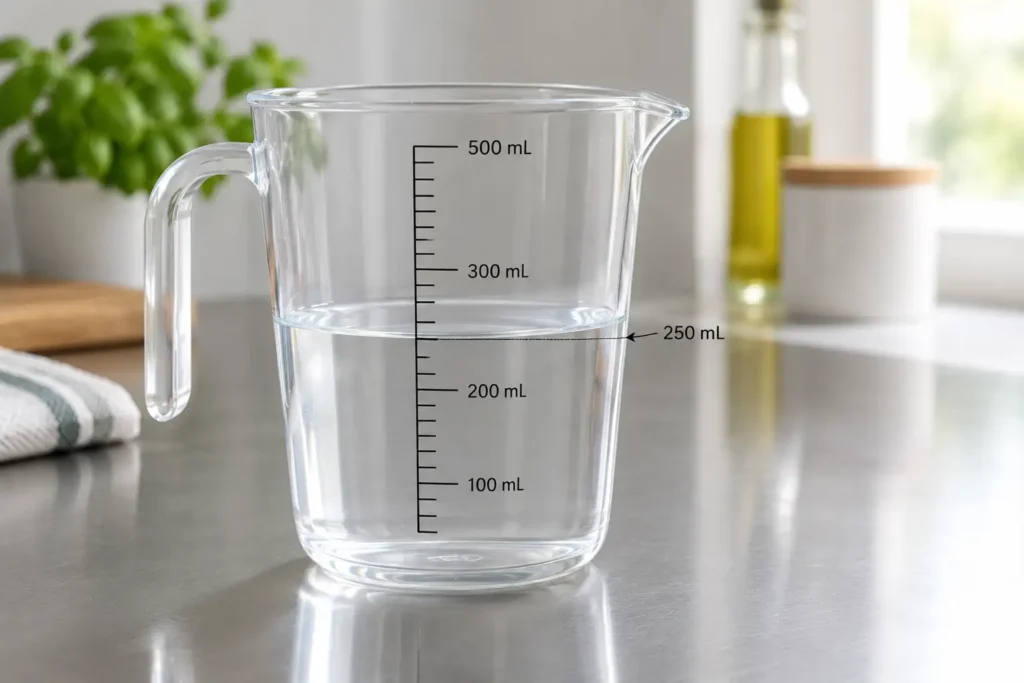
- 250 mL water = 250 g
- 250 mL milk × 1.03 = 258 g
- 250 mL honey × 1.42 = 355 g
- 250 mL olive oil × 0.91 = 228 g
- 250 mL all-purpose flour × 0.53 = 133 g
Use the swap button on the converter above to reverse the direction instantly.
Frequently Asked Questions
How many milliliters is 100 grams?
It depends entirely on the ingredient. Using our grams to milliliters converter, you’ll see that 100 g of water = 100 mL, 100 g of honey ≈ 70 mL, and 100 g of flour ≈ 189 mL.
Is 1 gram equal to 1 milliliter?
Only for water. Water has a density of 1 g/mL at 4°C, so 1 g of water = 1 mL. For every other ingredient, density is different, so the numbers diverge. Honey is much heavier (1 g ≈ 0.70 mL), while flour is much lighter (1 g ≈ 1.89 mL).
How do I convert grams to milliliters?
Divide the grams by the ingredient’s density in g/mL. For example, for flour (0.53 g/mL), 100 g ÷ 0.53 = 189 mL. Or just use the converter above — pick your ingredient and enter the gram value.
How do I convert milliliters to grams?
Multiply milliliters by the ingredient’s density. For honey (1.42 g/mL), 100 mL × 1.42 = 142 g. Click the swap button on our converter to do this automatically.
Is 100 g of flour the same as 100 mL of flour?
No. 100 g of all-purpose flour is about 189 mL — nearly twice the volume. Flour is much lighter than water, so the same weight takes up more space. This is why baking recipes in grams are more accurate than recipes in cups or milliliters.
Why do recipes sometimes use mL and sometimes grams?
European, Australian, and many Asian recipes often list liquid ingredients in milliliters and dry ingredients in grams. US recipes traditionally use cups and tablespoons. Our converter bridges the gap, so you can follow any recipe regardless of how it’s written.
Does temperature affect the conversion?
Slightly, but for cooking purposes, no. Water’s density changes from 1.000 g/mL at 4°C to about 0.997 g/mL at 25°C — a 0.3% difference. That’s negligible in the kitchen. The same applies to most liquids and semi-solids. Only very precise scientific work would need temperature-adjusted densities.
You Can Use This Tool Grams To ML