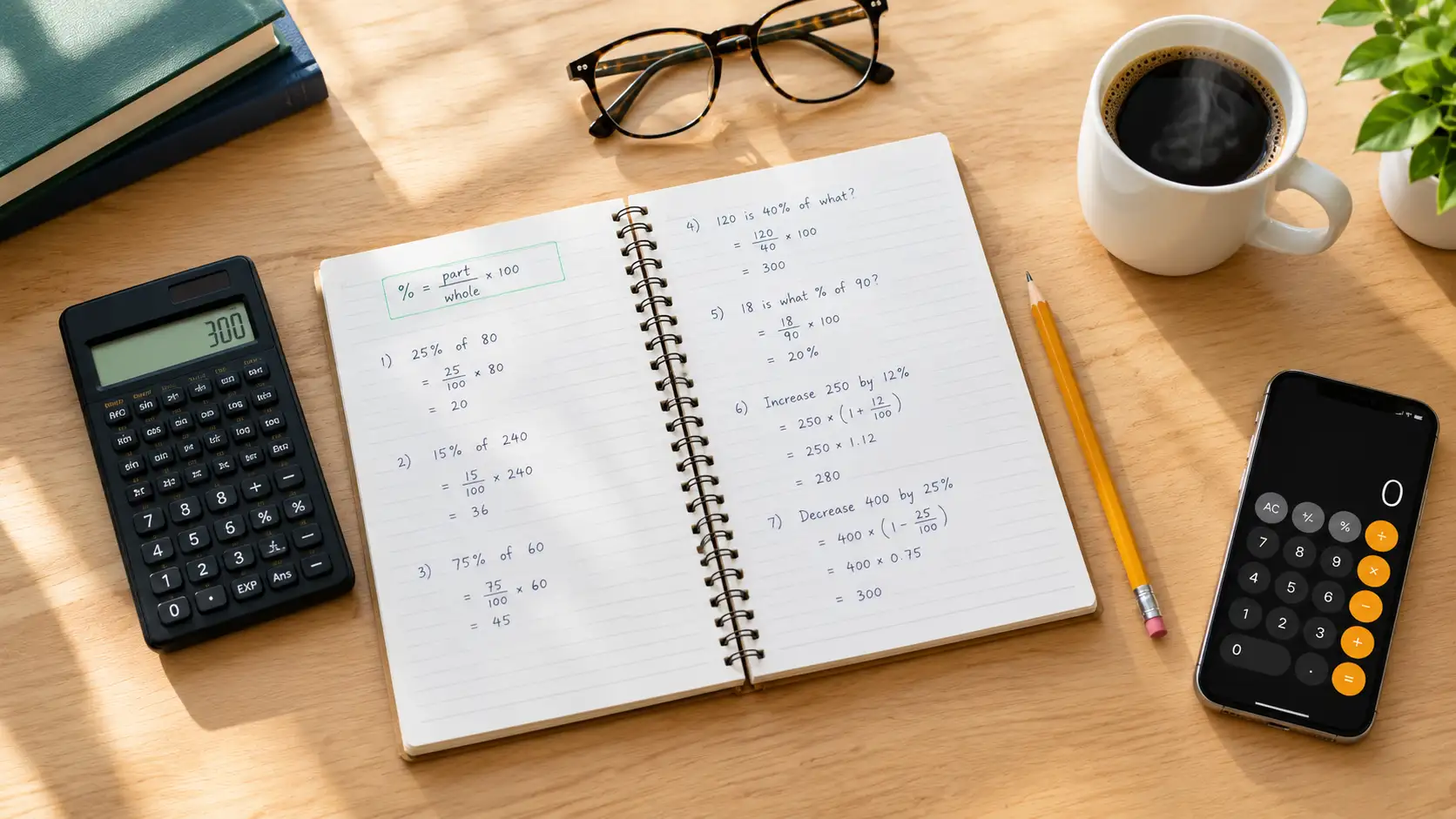
How to Calculate Percentages: Easy Guide with Examples
Percentages are everywhere. From a sale sign at your favorite store to a test score to your monthly budget, this simple math skill shows up more often than most people realize. And yet, many of us forget the exact formulas years after leaving school.
The good news? Calculating percentages is not difficult. Once you understand four basic formulas, you can handle nearly any percentage question that comes your way.
This guide walks you through each formula with clear examples. If you just want a quick answer, you can also use our free percentage calculator — it does the math instantly.
What Is a Percentage?
A percentage is a way of expressing a number as a part of 100. The word itself comes from the Latin “per centum,” which means “by the hundred.”
When you see 25%, it means 25 out of every 100. In decimal form, that is 0.25. In fraction form, it is one quarter.
Percentages are useful because they make comparisons easy. Saying “this item is 30% off” is much clearer than saying “this item costs 0.7 times the original price.”
Table of Contents
How to Calculate a Percentage of a Number
This is the most common type of percentage question. You have a percentage and a number, and you want to find the result.
Formula:
(Percentage ÷ 100) × Number
Example 1: What is 15% of 200?
Step 1: Convert the percentage to a decimal. 15 ÷ 100 = 0.15
Step 2: Multiply by the number. 0.15 × 200 = 30
Answer: 30
Example 2: What is 8% of 250?
Step 1: 8 ÷ 100 = 0.08
Step 2: 0.08 × 250 = 20
Answer: 20
This formula works for discounts, taxes, tips, and any situation where you need a fixed percentage of a base number.
How to Find What Percentage One Number Is of Another
Sometimes you know two numbers and want to find the percentage relationship between them. For example, you scored 42 out of 50 on a test — what percentage is that?
Formula:
(Part ÷ Whole) × 100
Example 1: 50 is what percentage of 200?
Step 1: Divide the part by the whole. 50 ÷ 200 = 0.25
Step 2: Multiply by 100. 0.25 × 100 = 25%
Answer: 25%
Example 2: You scored 42 out of 50. What is your percentage?
Step 1: 42 ÷ 50 = 0.84
Step 2: 0.84 × 100 = 84%
Answer: 84%
This formula is handy for test scores, sales targets, and any situation where you want to know how big one number is compared to another.
How to Calculate Percentage Increase or Decrease
When a value changes from one number to another, you can express that change as a percentage. This is common in finance, business, and everyday life.
Formula:
((New Value − Original Value) ÷ Original Value) × 100
Example 1: Increase from 80 to 100
Step 1: Find the difference. 100 − 80 = 20
Step 2: Divide by the original. 20 ÷ 80 = 0.25
Step 3: Multiply by 100. 0.25 × 100 = 25%
Answer: 25% increase
Example 2: Decrease from 100 to 80
Step 1: 80 − 100 = −20
Step 2: −20 ÷ 100 = −0.20
Step 3: −0.20 × 100 = −20%
Answer: 20% decrease
Important Note: If the original value is zero, percentage change cannot be calculated. Dividing by zero is undefined in math. Our percentage calculator handles this case with a clear error message instead of showing a broken result.
How to Add or Subtract a Percentage
Sometimes you want to add or remove a percentage from a number. For instance, adding tax to a price or applying a discount.
Formula for adding:
Number + ((Percentage ÷ 100) × Number)
Formula for subtracting:
Number − ((Percentage ÷ 100) × Number)
Example 1: Add 15% to 100
Step 1: 15 ÷ 100 = 0.15
Step 2: 0.15 × 100 = 15
Step 3: 100 + 15 = 115
Answer: 115
Example 2: Subtract 15% from 100
Step 1: 15 ÷ 100 = 0.15
Step 2: 0.15 × 100 = 15
Step 3: 100 − 15 = 85
Answer: 85
This is the same math you use when applying a discount at a store or adding sales tax to a purchase.
Common Mistakes to Avoid
Even simple math can trip people up. Here are a few common mistakes to watch for.
Mistake 1: Confusing percent change with percentage points.
If a value goes from 10% to 15%, that is a 5 percentage point increase — but a 50% increase in relative terms. These are two different numbers.
Mistake 2: Forgetting that percent changes are not symmetric.
Going from 100 to 80 is a 20% decrease. But going from 80 back to 100 is a 25% increase. The same values, different percentages.
Mistake 3: Dividing by zero.
Percentage change with an original value of zero is undefined. Always check the denominator before calculating.
Mistake 4: Rounding too early.
If you round in the middle of a calculation, small errors can grow. Keep full precision until the final step.
Real-Life Examples of Percentage Calculations
Percentages are not abstract — they show up in everyday situations. Here are a few examples.
Shopping Discounts
A jacket costs $120 and is on sale for 30% off. The discount is $36, and the final price is $84.
Test Scores
You scored 42 out of 50 on an exam. That is 84%.
Restaurant Tips
A $48 bill with a 20% tip adds $9.60, bringing the total to $57.60.
Salary Increase
Your salary went from $50,000 to $62,500. That is a 25% increase.
Weight Loss
You went from 180 pounds to 165 pounds — an 8.33% decrease.
Battery Life
Your phone battery dropped from 80% to 20%. That is a 75% decrease in charge.
When to Use a Percentage Calculator
Manual calculation is fine for simple, one-off problems. But a calculator saves time in several situations.
When you are in a hurry. Shopping, splitting a bill, or checking a discount — a calculator gives you the answer in a second.
When accuracy matters. For business reports, tax calculations, or financial planning, a calculator removes the risk of arithmetic mistakes.
When you are working with decimals. Long decimal numbers are easy to misplace when doing mental math.
When you want to see the formula. Many calculators, including ours, show the formula used so you can learn from the result.
If you find yourself doing these calculations often, try our free percentage calculator — it handles all four types of problems in one tool.
Percentage Formulas Cheat Sheet
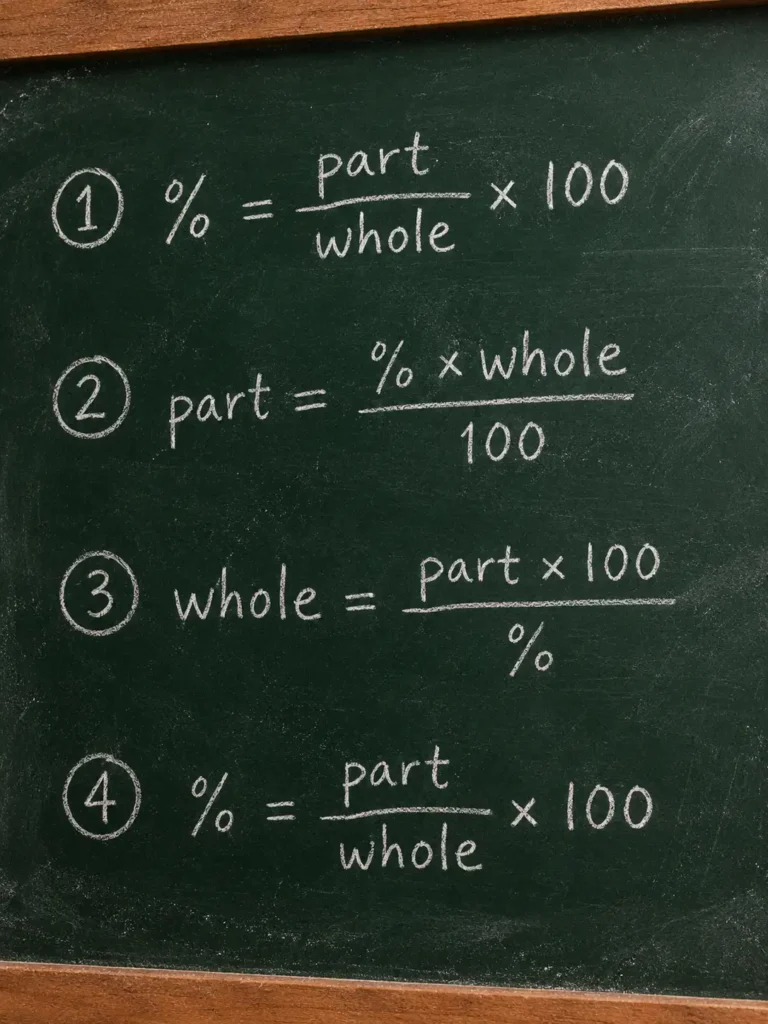
Keep these four formulas handy:
1. Percent of a number:
(Percentage ÷ 100) × Number
2. What percent one number is of another:
(Part ÷ Whole) × 100
3. Percent change:
((New Value − Original Value) ÷ Original Value) × 100
4. Add or subtract a percent:
Number ± ((Percentage ÷ 100) × Number)
That is all you need for almost every percentage question.
Frequently Asked Questions
What is the easiest way to calculate a percentage?
Convert the percentage to a decimal by dividing by 100, then multiply by the number. For example, 15% of 200 is 0.15 × 200 = 30.
How do I calculate percent change?
Subtract the original value from the new value, divide by the original value, and multiply by 100.
Can percentages be negative?
Yes. A negative percentage usually represents a decrease. For example, a −20% change means the value went down by 20%.
What happens if I divide by zero in a percentage change calculation?
The result is undefined. Mathematically, dividing by zero has no meaning, so the percentage change cannot be calculated.
Do I need a calculator to find percentages?
Not for simple cases. But for decimals, large numbers, or repeated calculations, a calculator is faster and more reliable.
Percentages are a basic life skill. Once you know the four main formulas, you can handle almost any percentage question — from a sale tag to a business report.
If you want a faster way, bookmark our percentage calculator. It handles all four calculations instantly and shows you the formula behind each answer.
You can also explore our other free tools, including the Age Calculator, for everyday calculations.
About the Author: Md Rasel Hossain is the founder of A2ZToolbox. He built the percentage calculator after getting tired of doing mental math every time he shopped online.