
Cup to Gram Converter
Convert between cups and grams for 140+ ingredients. Ingredient-specific weights, instant results, and a swap button for two-way conversion.
Click to browse all 140+ ingredients, or type to search.
Ingredient weights can vary depending on how an ingredient is measured, packed, or scooped. Results are estimates based on standard reference measurements.
Quick Conversion Table
| Cups | Grams |
|---|---|
| 1/4 cup | 31.25 |
| 1/3 cup | 41.63 |
| 1/2 cup | 62.5 |
| 2/3 cup | 83.38 |
| 3/4 cup | 93.75 |
| 1 cup | 125 |
| 1 1/2 cups | 187.5 |
| 2 cups | 250 |
| 3 cups | 375 |
| 4 cups | 500 |
Values shown for All-Purpose Flour. Change the ingredient above to update.
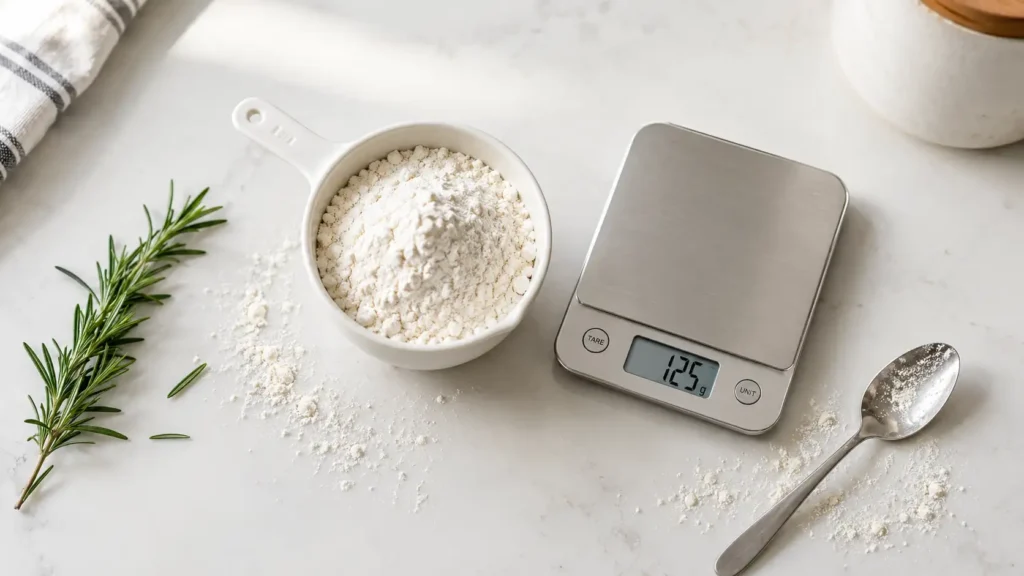
Whether you’re following a US recipe that lists ingredients in cups or a European one that uses grams, getting the right amount matters. Our cup to gram converter handles the math instantly for over 140 ingredients — from all-purpose flour and granulated sugar to butter, honey, and cocoa powder. Just type a number, pick your ingredient, and see the gram value in real time. The swap button lets you convert grams to cups just as easily, so you can move between both measurements without switching pages.
Unlike generic converters that assume “1 cup = 240 grams” for everything, this tool uses ingredient-specific reference weights. That means 1 cup of flour weighs about 125 grams, while 1 cup of sugar weighs about 200 grams — and both values are correct.
How to Convert Cups to Grams
Converting cups to grams is straightforward once you know the ingredient’s density. Volume (cups) measures how much space an ingredient takes up; weight (grams) measures how heavy it is. Because every ingredient has a different density, the same cup will weigh different amounts depending on what you’re measuring.
The formula is simple:
grams = cups × grams per cup (for that ingredient)
For example:
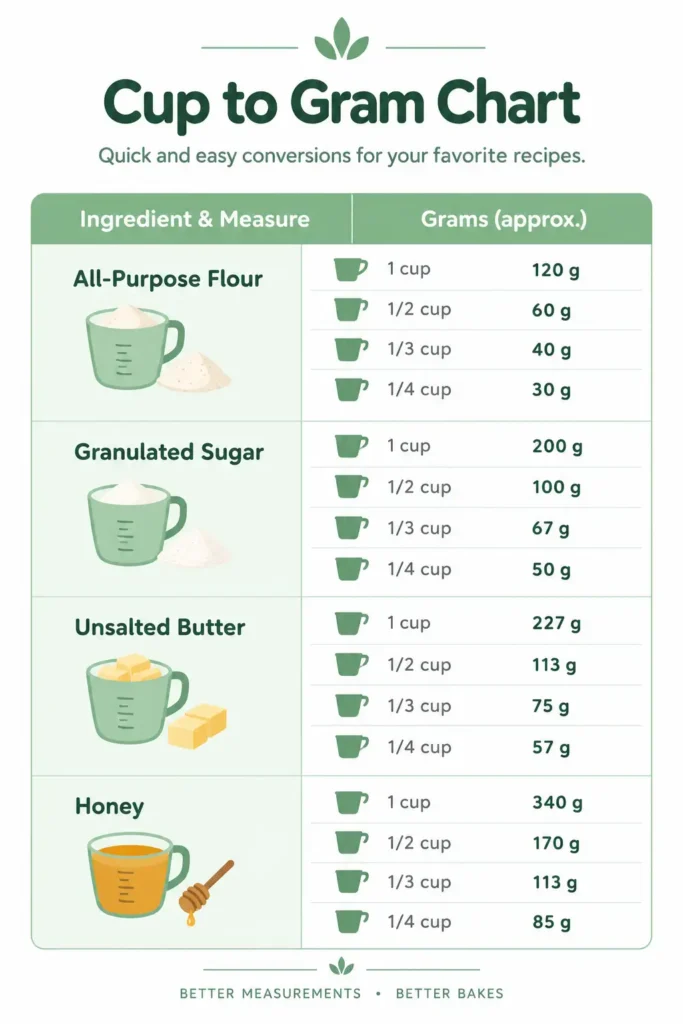
- 1 cup all-purpose flour = 125 g → 2 cups = 250 g
- 1 cup granulated sugar = 200 g → ½ cup = 100 g
- 1 cup butter = 227 g → ¼ cup = 57 g
- 1 cup honey = 340 g → ½ cup = 170 g
Our converter does this calculation automatically when you select an ingredient from the dropdown.
Table of Contents
Common Cup to Gram Conversions
Here’s a quick reference for the most-searched ingredients. For a full list, use the interactive table above.
Ingredient weights on this page follow reference values published by the USDA FoodData Central database.
Cups to Grams for Flour
| Cups | All-Purpose Flour | Bread Flour | Whole Wheat Flour |
|---|---|---|---|
| ¼ cup | 31 g | 32 g | 30 g |
| ⅓ cup | 42 g | 42 g | 40 g |
| ½ cup | 63 g | 64 g | 60 g |
| 1 cup | 125 g | 127 g | 120 g |
| 2 cups | 250 g | 254 g | 240 g |
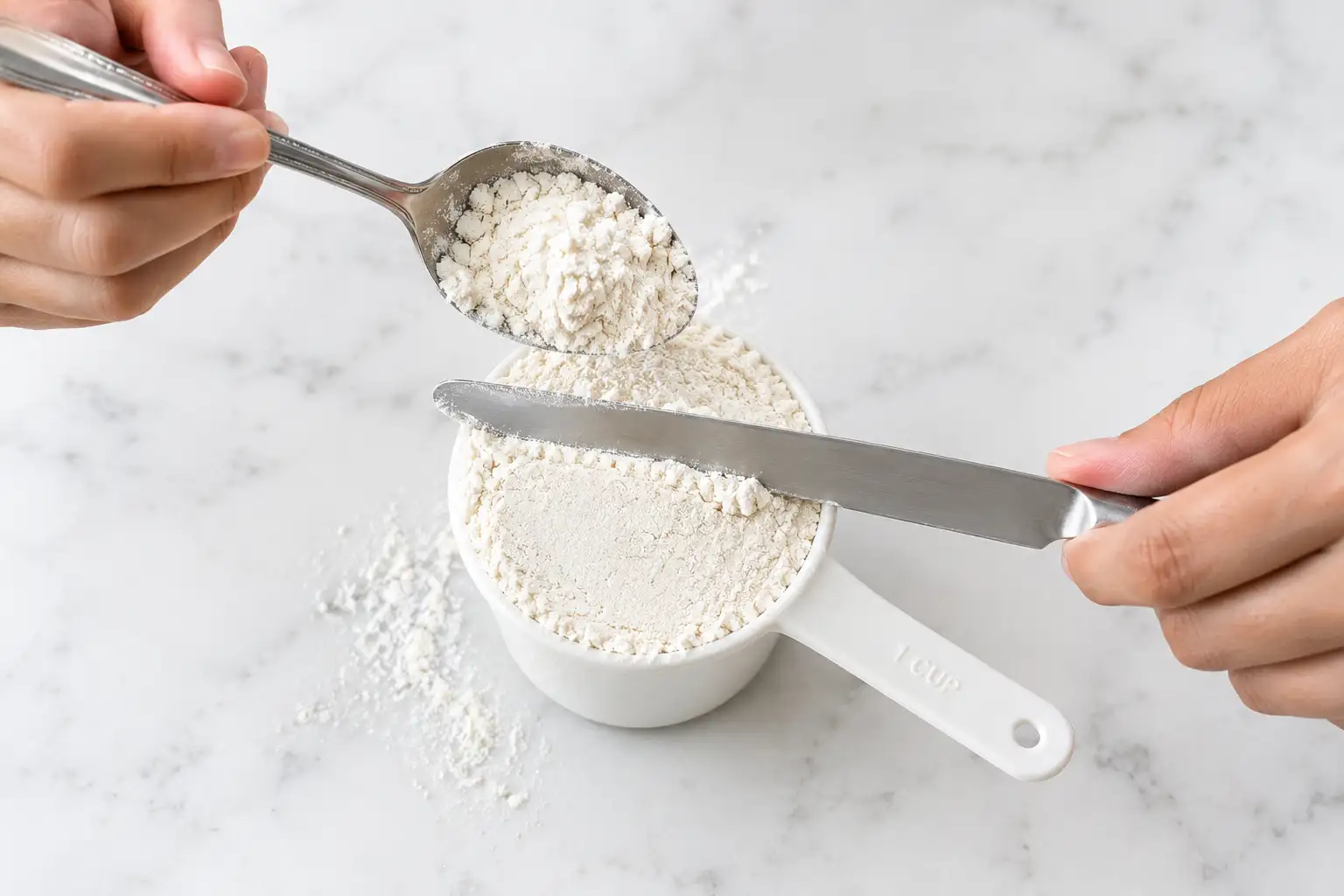
Note: Scooping method changes the result. A “spooned and leveled” cup of flour weighs about 125 g, while a “scooped” cup can weigh up to 150 g. For best accuracy, spoon flour into the cup and level it off with a knife.
Cups to Grams for Sugar
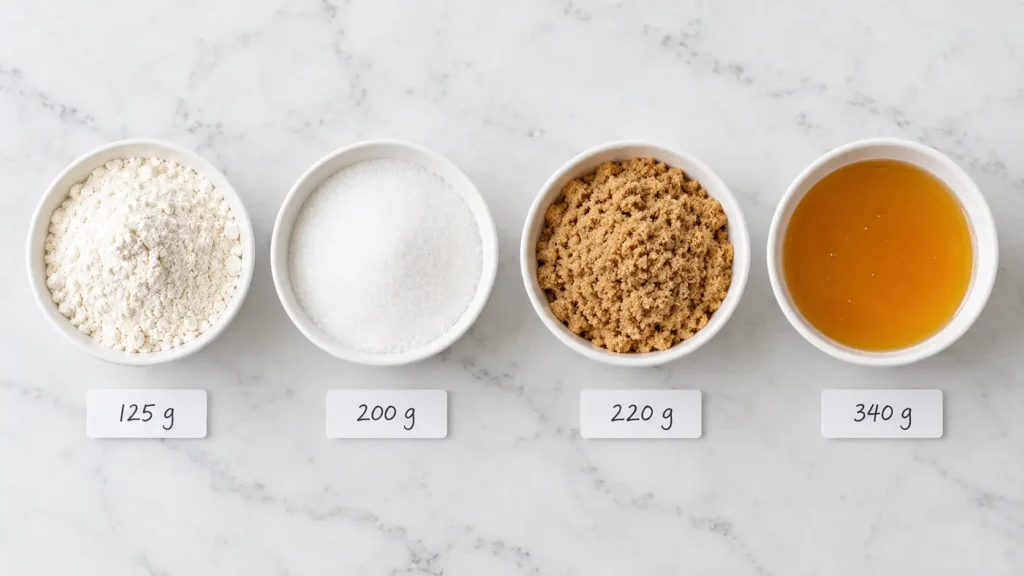
| Cups | Granulated | Brown (packed) | Powdered |
|---|---|---|---|
| ¼ cup | 50 g | 55 g | 30 g |
| ½ cup | 100 g | 110 g | 60 g |
| 1 cup | 200 g | 220 g | 120 g |
Cups to Grams for Butter and Fats
| Cups | Butter | Coconut Oil | Vegetable Oil |
|---|---|---|---|
| ¼ cup | 57 g | 55 g | 55 g |
| ½ cup | 113 g | 109 g | 109 g |
| 1 cup | 227 g | 218 g | 218 g |
Cups to Grams for Liquids
| Cups | Water | Milk | Honey |
|---|---|---|---|
| ¼ cup | 59 g | 61 g | 85 g |
| ½ cup | 118 g | 122 g | 170 g |
| 1 cup | 237 g | 244 g | 340 g |
Why Ingredient-Specific Weights Matter
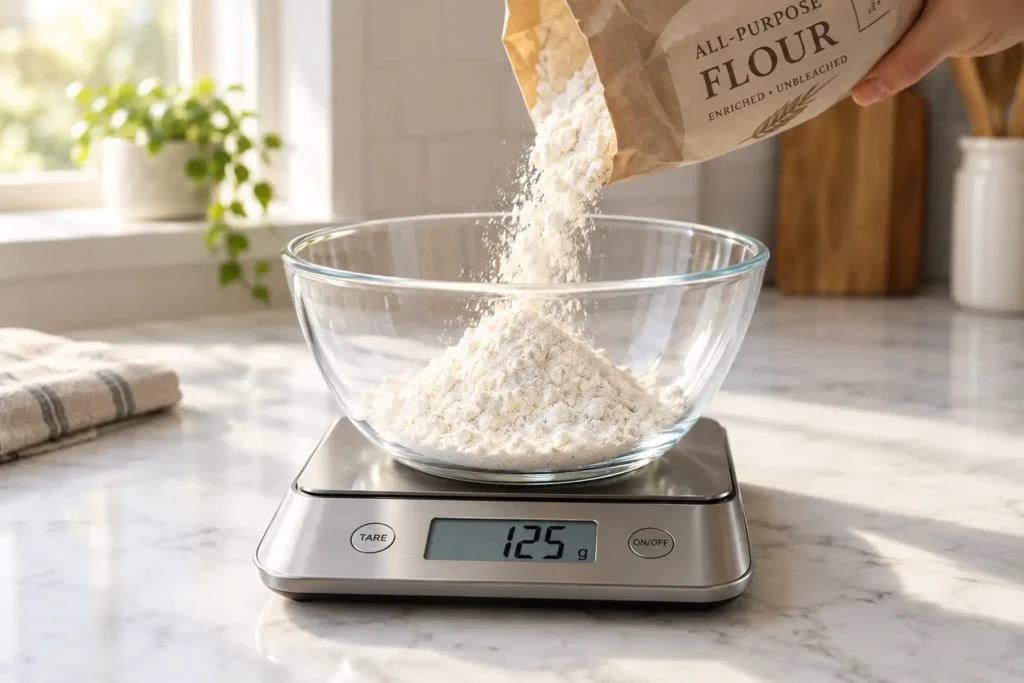
If you’ve ever baked a cake that came out dry, dense, or crumbly, the culprit is often too much flour. Most people scoop flour directly from the bag — which can pack in 20–30% more than the recipe intended.
A recipe that says “1 cup flour” usually means 125 grams, but a scooped cup can weigh 150 g or more. That’s the difference between a light, tender cake and a heavy brick.
Using a cup to gram converter removes the guesswork. Weighing your ingredients in grams is the single biggest upgrade you can make to your baking — professional bakers do it for a reason. It’s faster, more accurate, and produces consistent results every single time.
For the most precise results:
- Use a digital kitchen scale (any $15–$30 scale works)
- Place your bowl on the scale, press “tare” to zero it
- Spoon the ingredient in until you hit the gram target
- No measuring cups needed
Converting Grams to Cups
The reverse conversion works the same way, just in the opposite direction. Select “Grams” as your starting unit (or click the swap button), enter the gram value, and the tool shows you the equivalent in cups.
Formula:cups = grams ÷ grams per cup (for that ingredient)
Examples:
- 250 g all-purpose flour = 2 cups
- 200 g granulated sugar = 1 cup
- 113 g butter = ½ cup
- 100 g honey ≈ 0.29 cups (about ¼ cup + 1 tbsp)
This is especially useful when you’re working from a European or Australian recipe that lists everything in grams, but your measuring cups are in US units.
Frequently Asked Questions
How many grams are in 1 cup?
It depends on the ingredient. 1 cup of all-purpose flour weighs about 125 g, 1 cup of granulated sugar is about 200 g, 1 cup of butter is about 227 g, and 1 cup of water is about 237 g. Use the ingredient selector above for exact values.
How many grams is 1 cup of flour?
1 cup of all-purpose flour is approximately 125 grams when spooned and leveled. Bread flour is 127 g, cake flour is 114 g, and whole wheat flour is 120 g. If you scoop directly from the bag, expect 140–150 g.
How many grams is 1 cup of sugar?
1 cup of granulated sugar weighs 200 grams. Brown sugar (packed) is about 220 g, and powdered sugar is about 120 g. Sugar is denser than flour, so a cup weighs significantly more.
Is 1 cup always 240 grams?
No. This is a common myth. 240 g only applies to water and other liquids with similar density. Every dry ingredient has its own weight — flour is lighter, sugar is heavier. Always use an ingredient-specific conversion.
How do I convert grams to cups?
Divide the grams by the ingredient’s grams-per-cup value. For example, 250 g of all-purpose flour ÷ 125 g/cup = 2 cups. Or simply use the swap button on our converter above.
Why does my cup of flour weigh more than 125 g?
Because you’re probably scooping directly from the bag, which compresses the flour. Try the “spoon and level” method: spoon flour into the cup, then level it off with the back of a knife. Or better yet — use a kitchen scale.